
Region’s water agency names interim director as commissioner pushes for green infrastructure in $2.3 million roof repair
The roof of the Egan water reclamation plant in northwest suburban Schaumburg, managed by the MWRD, will undergo repairs.
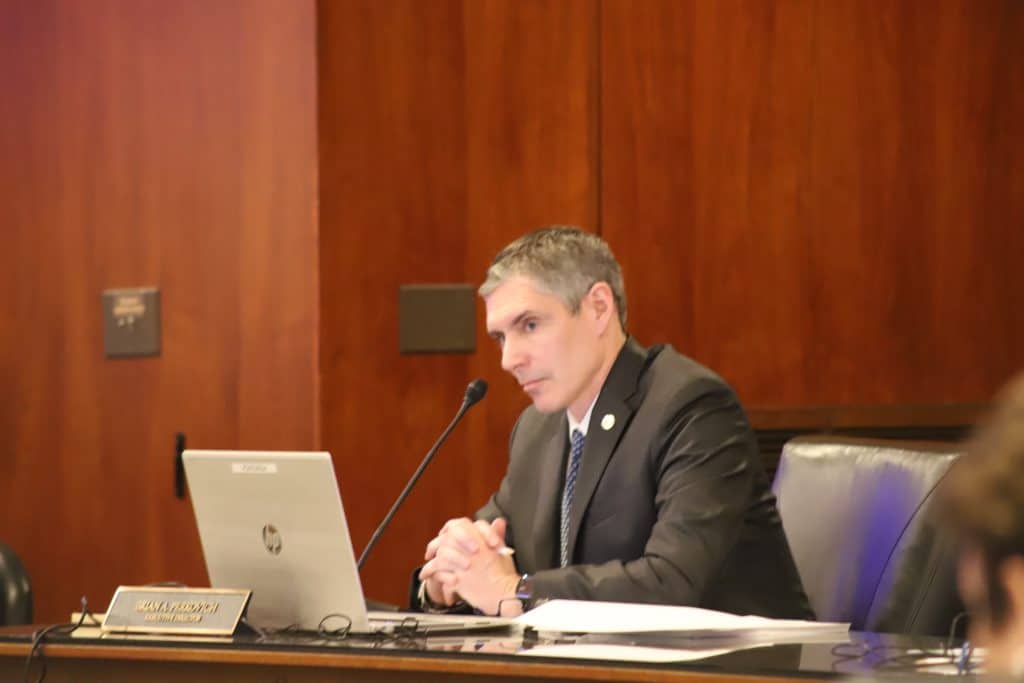
The Metropolitan Water Reclamation District commissioners appointed John Murray, a 17-year veteran of the public agency, as the new interim executive director.
Director Brian Perkovich is retiring. Perkovich has been with the District for over 30 years, starting as a civil engineer and transitioning to executive director in 2018.
Murray, who currently serves as director of the maintenance and operations department, has worked on the district’s stormwater management, local sewer systems, and biosolids management programs.
Official business
Commissioners approved a motion to advertise a $2.3 million roof repair contract at the Egan water reclamation plant in northwest suburban Schaumburg despite one commissioner’s concerns about the project’s adherence to environmental standards.
Commissioner Precious Brady-Davis questioned why the Egan water reclamation plant project proposal doesn’t adhere to the Illinois Green Infrastructure Plan to mitigate stormwater runoff.
“They have to be replaced, regardless if we put a green roof on or not,” Perkovich said at a March 6 board meeting. “So the roof itself, the underlying roof, is in bad shape; that’s what we’re fixing.”
Green infrastructure adjustments will be included in future contracts at the site, Murray explained to the board. He explained that the roof must be repaired and reinforced before adding a green roof element, which involves installing a garden of native plants to absorb rainwater.
The Egan plant features other stormwater-friendly infrastructure, such as a water-permeable parking lot, Murray said.
All District facilities undergo assessments to identify infrastructure needs and develop a maintenance schedule, Perkovich said, with commissioners emphasizing making green infrastructure a priority in maintenance plans.
While the board ultimately approved a contract to a company to help transport the District’s waste, Commissioner Sharon Waller opposed it.
The county’s water treatment systems produce air-dried biosolids, which are disposed of elsewhere. According to Waller, Cook County generates 150,000 dry tons of biosolid waste annually.
“I would like to see the district adopt a policy for reuse of both water and solids that will end land application of biosolids on farm fields as it is currently done …” Waller said. “I plan to vote no with faith that we can find a better solution with our seventh generation in mind.” Waller and Davis encouraged the release of a consultant’s report on the district’s waste management.
Cook County School District 130 can now operate and maintain a 12-inch storm pipe along the Cal-Sag Channel in Blue Island, after board approval. The Grande Prairie Water Commission, a southwest suburban water supplier, was approved to conduct soil surveying for 12 months on District property in the villages of Palos Park and Palos Hills.
Federal ruling
Commissioner Marcelino Garcia discussed the Supreme Court’s recent ruling over sewage permits in California, which could impact the Environmental Protection Agency’s authority to regulate water pollution under the Clean Water Act of 1972.
“I feel that while the federal government and the Supreme Court may eradicate and try to sweep away certain things, I think we still need to be committed to the current standards that were done under the previous administrations,” Garcia said. “Our job and the job of this agency is to still protect health and safety.”
But the District will maintain its commitment to high-quality treatment processes, President Kari Steele said.
“Our treatment process is not going to be reduced or watered down,” Steele said. “Even though someone requires less of us, that doesn’t mean we are going to lower our standards.”
We’re filling the void after the collapse of local newspapers decades ago. But we can’t do it without reader support.
Help us continue to publish stories like these
Author

Related Articles

Why is electricity so expensive in the Midwest?
The culprit depends on where you live — but it’s probably not data centers (yet).

EyeOnWater helping Phoenix residents avoid high water bills by spotting leaks
The free online tool allows users to track water usage and set up leak alerts.
All hell breaks loose at Harvey Park District board meeting over alleged mismanagement
The board abruptly adjourned less than 10 minutes after two commissioners called foul on operations, leadership, and finances.

