
Organizers want to object to a climate initiative forcing out longtime residents. It’s not that simple.
A petition to protest a water detention pond on 153rd Street & Myrtle Avenue has hundreds of signatures to date. But it’s unclear to whom and where its organizers need to submit them.
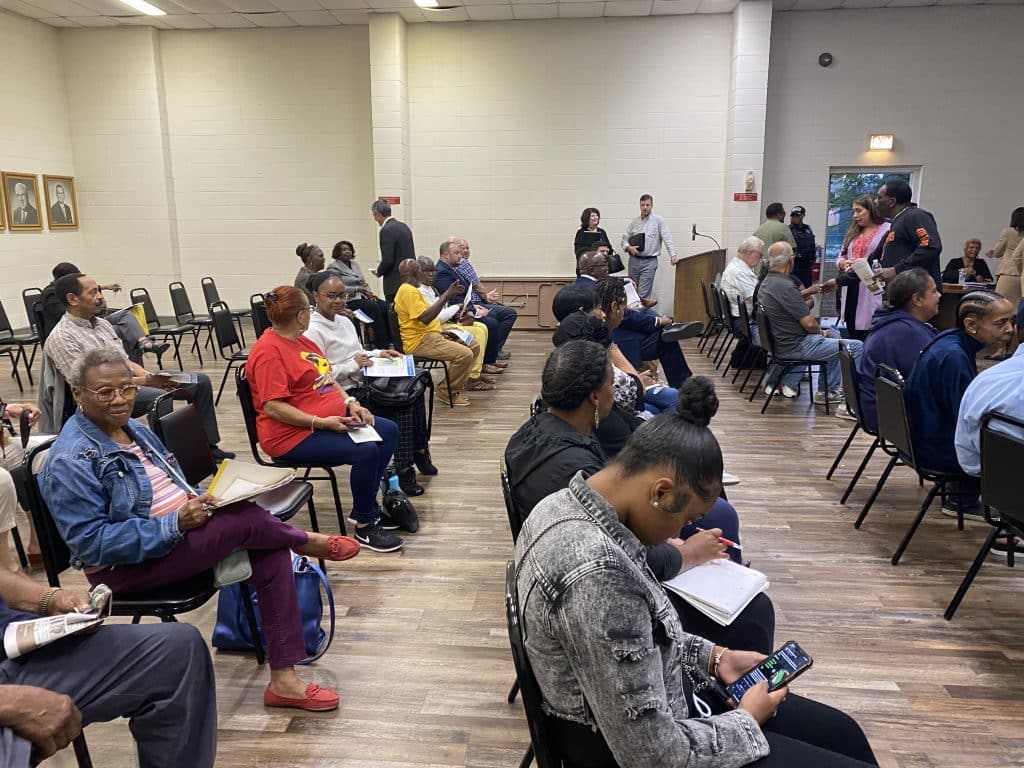
A citywide petition is underway to contest a stormwater management project. But submitting community objections and petitions are an uphill battle.
Officials at the local, state, and federal level are unclear where petitions should be sent—or if they can, at all.
“We didn’t know they were coming,” said Mauzkie Ervin, former Harvey Public Library Board trustee who has circulated a petition, which has over 500 signatures to date.
“They could have given residents the option to take the money for displacing them or the option to allow them to stay if they wished.” The District has stated that’s not possible, with the current site, the best to allow for the flow of water from the basin.
The Metropolitan Water Reclamation District, the regional stormwater treatment facility spearheading the project, plans to fully finance a water detention pond on 153rd Street & Myrtle Avenue, which includes federal financing.
The District has said it’s an estimated $9.85 million endeavor, but its application projects a little over $7 million. The District applied for $5 million in Building Resilient Infrastructure and Communities dollars from the Federal Emergency Management Agency last summer.
If approved, the recipient must fund 25%, which the District expects to do using general operating funds, according to its application, obtained by the HWH from the state via public records request.
Alderwoman Colby Chapman (2nd), who has said mayoral officials didn’t tell her of the effort though they knew residents would be displaced, expressed her frustration over the lack of prior notification about the water detention basin construction.
She’s launched several unsuccessful attempts to see the site moved.
In September 2023, the City Council approved an intergovernmental agreement with the District for the project. Moments before, Chapman attempted to move the measure to the economic development committee, which she chairs, for further discussion.
But that motion failed. The Council passed the IGA, 4-2. Weeks prior, she’d emailed the District urging the basin be relocated.
Chapman’s skeptical of the background research the District conducted, believing “they couldn’t have taken into consideration the families whose entire lives would be affected by this,” Chapman said.
“There are Black and Brown families here, some of them being 80 years old, who had no idea they would have to move out of the home they worked their whole lives to have.”
Government bureaucracy and community objections
It’s unclear when and where petitions would appear in the BRIC application process.
A FEMA spokesperson told the HWH that community or public objections/ petitions concerning a project after the grant has been awarded would be handled locally—after a grant has been awarded.
But when the HWH inquired about petitions with the District, it directed those matters to FEMA.
Myrtle Ave. residents have expressed zero confidence in Mayor Chris Clark to contest the project’s location. Clark was seen laughing with Alderman Dominique Randle-El (5th) at last year’s town hall about the project and smirking while residents complained of displacement. Visibly frustrated, he exited the meeting before it was over while District President Kari Steele was talking.
The mayor’s office did not respond to multiple requests for comment.

Vincent D. Pinelli is a lawyer at Burke Burns & Pinelli in downtown Chicago, a practice that specializes in areas like eminent domain.
According to Pinelli, the District and FEMA aren’t required by law to provide advance notice or allow community objections in most public domain cases, seeing as said projects are often considered for the “greater good” of the community.
Government officials’ will negotiate the sale of property titles with homeowners. If they can’t reach an agreement, the District can take legal action for property rights, Pinelli said.
A storm water detention basin would typically fall under the category of a public domain project, he added.


Understanding the BRIC application process
A sub-applicant like the District submits projects to the applicant, the state—in this case, the Illinois Emergency Management Agency—for review. That information is then submitted to FEMA by the IEMA. States may have specific criteria for screening sub-applications.
Once received, FEMA conducts a review, assigning a status to each application: “did not meet HMA requirements,” “not selected,” and “identified for further review.” FEMA formally announces the status and undertakes additional pre-award review, if necessary.
The District’s application was selected for further review, FEMA announced in August. That doesn’t guarantee funding. According to a FEMA spokesperson, however, sub-applications earmarked for further review provide sufficient information for an initial assessment of cost-effectiveness and feasibility.
There isn’t a timeline for the pre-award review, but if the District were to begin construction prior to a funding decision, its request could be terminated. During this phase, applicants receive information about required environmental and historic preservation review, verification of sub-applicant commitments, and its hazard mitigation plan status, according to a FEMA spokesperson.
At that time, Illinois applicants are encouraged to closely collaborate with their FEMA regional contacts, namely the state hazard mitigation officer, with questions or concerns.
That’s where Sam Al-Basha, Illinois’ mitigation hazard officer, would come in.
Al-Basha did not respond to multiple requests for comment by press time, but they’ve been in direct contact with the District since September 2022, according to emails obtained by the HWH via public records request.
The District attempted to submit the application in 2021, Al-Basha wrote in November 2022 to Anne Wright, the District’s grant writer. FEMA didn’t select any sub-applications for that fiscal year. The District would resubmit for the next fiscal year, Wright responded.
Al-Basha apprised Wright of direct technical assistance—planning and design help—that FEMA could offer Harvey, but Wright declined.
“Harvey is a shovel-ready project and the City and residents have pretty good momentum behind and support of the project,” Wright responded last January—six months before the District and city officials actually notified Myrtle Ave. residents.
In spring 2023, Al-Basha, the District, HRGreen—the project’s design consultant, and city officials held in-person meetings at City Hall to discuss the project, emails show.
The District has repeatedly told residents the project couldn’t be moved because doing so would balloon costs and jeopardize its grant application for federal dollars.
But should an award be issued and an applicant wants to deviate from its initial scope, applicants can submit a request to FEMA to change the budget and scope of work, according to the agency.
If approved for changes, award recipients would report those to FEMA, in accordance with hazard mitigation program guidelines. Should an award recipient move forward with changes prior to the federal agency’s prior approval, funds could be disallowed.
We’re filling the void after the collapse of local newspapers decades ago. But we can’t do it without reader support.
Help us continue to publish stories like these
Author

Related Articles
Harvey seeks $500,000 for aging water infrastructure
The city will apply for the federal funding to ease water main breaks after the City Council approved the measure during the March 9 meeting.

PHOTOS: In Dixmoor, a Cook County commissioner’s home languishes
While the 5th district’s Kisha McCaskill claims tax exemptions that reduce her bill on a Dixmoor home, it’s become an eyesore without proper upkeep.
Cook County Commissioner Kisha McCaskill claims tax exemptions on abandoned Dixmoor property
Although she claims homeowner and senior exemptions, McCaskill does not reside in the home, which is a vagrant. The Cook County Assessor’s Office has referred the matter to its erroneous exemption department for investigation.

