
With rampant drug trafficking, MWRD doubles down on stormwater initiative
Fentanyl overdoses and carjackings aren’t stopping the water treatment agency from building a pond on 153rd St. and Myrtle Ave.

The region’s water treatment agency is standing by a near $10 million water detention pond on 153rd St. and Myrtle Ave. after a man overdosed at a city-owned property at the center of the project last winter.
Brandon Gross, Sr., 55, overdosed on a lethal combination of fentanyl and cocaine at Ascension-St. Susanna Catholic Church campus in December 2023.
The Metropolitan Water Reclamation District is forging ahead with a dual-use pond and civic park project that aims to reduce urban flooding in the face of a 100-year storm event. It will also result in 10,000 new storm sewers and more than 7.5 million gallons of stored runoff water, preventing basement backups, according to the District.
On the city’s end, Harvey will transform Ascension-St. Susanna into a civic center and park directly across from the pond. Last fall, the city withdrew its application for state funding to convert the campus and officials haven’t publicly stated if they will apply again, but it’s likely they will.
District Board of Commissioners President Kari Steele declined to answer questions regarding the area’s drug problems in a statement sent to the HWH, instead highlighting a projected 209 properties that will benefit from flood relief, business growth, and an increase in property values.
“For far too long, Harvey residents have had to endure flooding and sewage backup in their basements, causing damage to homes and the loss of personal possessions and disrupted lives. This flood control project will provide relief to many homeowners,” Steele said. “MWRD engineers have found that the basin at Myrtle Avenue and 153rd Street is the most ideal location. It has the proper elevation, it is near other drainage pipes and it is central to the area where they seek to alleviate flooding.”
The project site, however—153rd St. and Myrtle Ave.—is at the center of one of Harvey’s decades-long stubborn drug markets. In the 1980s, the issue was crack cocaine. Today, it’s a medley of that, opioids, and heroin.
The city has continually failed to secure the Ascension-St. Susanna area vandals. After Gross, Sr.’s death, city laborers still left a back gate open, allowing entry onto the property. Even with a security camera placed onto the campus, people tore down the plywood to access the church. Break-ins still occur at the rectory.
The area is also experiencing carjackings and robberies, according to the county’s 911 phone call records.
Mayor Chris Clark’s office hasn’t publicly acknowledged Gross, Sr.’s death on city-owned property and did not notify the District. The District first became aware of Gross, Sr.’s death after the HWH reached out to the District for comment in February.
Harvey is responsible for pond maintenance and upkeep upon completion. A District spokesperson directed all inquiries about the park or any “non-stormwater amenities it may pursue in the future” to Harvey officials.
The mayor’s office did not respond to requests for comment for this story.


The relocation process
Residents were first alerted in July 2023. Harvey and District officials held two meetings at City Hall with impacted residents. The mayor’s office did not alert Ald. Colby Chapman (2nd) that several constituents would be displaced, igniting continuous tension between the two.
The District’s appraiser conducted its first assessment of homes in October 2023. A second assessment was performed in February 2024. Those results, used to determine the amount of financial assistance included in residents’ relocation packages, were not provided to residents.
Offer letters were sent in May. Residents had five weeks to respond. After she received hers, Poole-Tingle didn’t go to work because of the emotional stress, she said. She took a five-week medical leave from work.
The Poole-Tingle household received an extension through July 31. Now, they’ve been told to relocate by early November. With financial assistance in hand, the District gave families roughly six months to relocate.
For parents like Poole-Tingle, they’re also tasked with finding new schooling for children. A District attorney previously told the HWH staff were committed to helping families avoid changing schools mid-year, “where possible.”
Harvey youth head back to school this month. With families forced to vacate within the next three weeks, that leaves parents like Poole-Tingle with less than a semester to find new schooling.

Determining the site location and inconsistent rhetoric
Post-industrial communities like Harvey have loads of impermeable pavement, making it harder for stormwater to run off. The absence of green infrastructure, which would help capture rainwater, agitates that problem.
In 2018, Harvey approached the District for assistance for flooding woes in the area of 147th St. and Wood St., a mile northwest of the current site, as part of the Stormwater Partnership program.
“This partnership project came to fruition through many years of collaboration with the City,” said a District spokesperson, “that involved a detailed engineering analysis of existing drainage infrastructure, reported flooding issues, available funding sources, and potential alternatives.”
In her statement, Steele said engineers ruled out land further west, including the area where Dixie Square Mall once stood. “It is on higher ground and there are other main water diversion pipes crossing the path. Water runs toward the lower point. Dixie Square is not the lowest point,” Steele said. “We can’t defy the law of gravity.”
In August 2023, District Director of Engineering Catherine O’Connor wrote a letter to Myrtle Ave. dwellers. In it, she said the site location was determined by the city’s desire to build a central park.
In September 2023, city and District officials held a town hall about the endeavor.
That evening, Clark said the park location would’ve been wherever the District proposed the basins. When the Archdiocese of Chicago closed the Ascension-St. Susanna parish in 2022, “it gave us another opportunity to build a pond—what was already suggested—based on the results,” Clark said.
Soon, a shouting match ensued as Poole-Tingle contested those comments.
“And we’re gonna ask them if they wanna correct the record,” Clark eventually responded.
On the defensive, Clark yelled back-and-forth with Poole-Tingle and Dorothy Taylor, 85, while offering conflicting and self-indulged rebuttals about the initiative. At one point, Clark suggested he told residents to see him at City Hall, but moments prior said he had not chosen to meet with residents because they had “already painted me with a brush.”
Before the meeting ended, as Steele delivered her final words, Clark walked out of the meeting and into his office.
Listen to the back-and-forth here:
A week after Clark suggested he wanted the District to change its tune on how it determined the final site location, O’Connor wrote a second letter. In it, in question 3, she frames the park as a tangential project that incorporates the District’s detention basin, disconnecting the two endeavors from one another in terms of determining exact location, similar to Clark’s assertion at the town hall.
During the research phase two years ago, consultant HRGreen studied a broad swath of Harvey, as far west as Wood St. southwest of the CSX railway, 147th St. to the north, and as far south as 154th St., according to HRGreen’s preliminary engineering report, obtained by the HWH via public records request. Researchers also considered proximity to UChicago Medicine Ingalls Memorial Hospital and the Wood St. infrastructure project.
They called city officials’ desire to build a park “a focal point in the alternative analysis phase” that “guided the selection of the preferred alternate.”
Weeks after that contentious town hall, the City Council approved an intergovernmental agreement authorizing the project, 4-2. Alds. Chapman and Tracy Key (4th) cast the only dissenting votes.
In October 2023, Clark attended a joint ward meeting held by Chapman and Key. There, Clark said that project was something that people were “mad at him” even though it “wasn’t his fault,” as he briefly looked at Poole-Tingle, who attended.
Mayor Chris Clark allegedly retaliates against Myrtle Ave. homeowner
In November 2023, Clark told WBEZ Chicago that he twice knocked on residents’ doors to discuss the project. On social media, Poole-Tingle immediately accused Clark of lying, saying he hadn’t actually met with any residents at that time.
This April, Ald. Chapman and Poole-Tingle visited Rep. Robin Kelly’s Matteson office to make a final push to halt the project. Kelly wrote Clark a letter advising him to meet with Myrtle Ave. residents.
The following month, Clark met with Poole-Tingle and supporters like Ryan Winwelski, a former mayoral ally and planning commissioner.
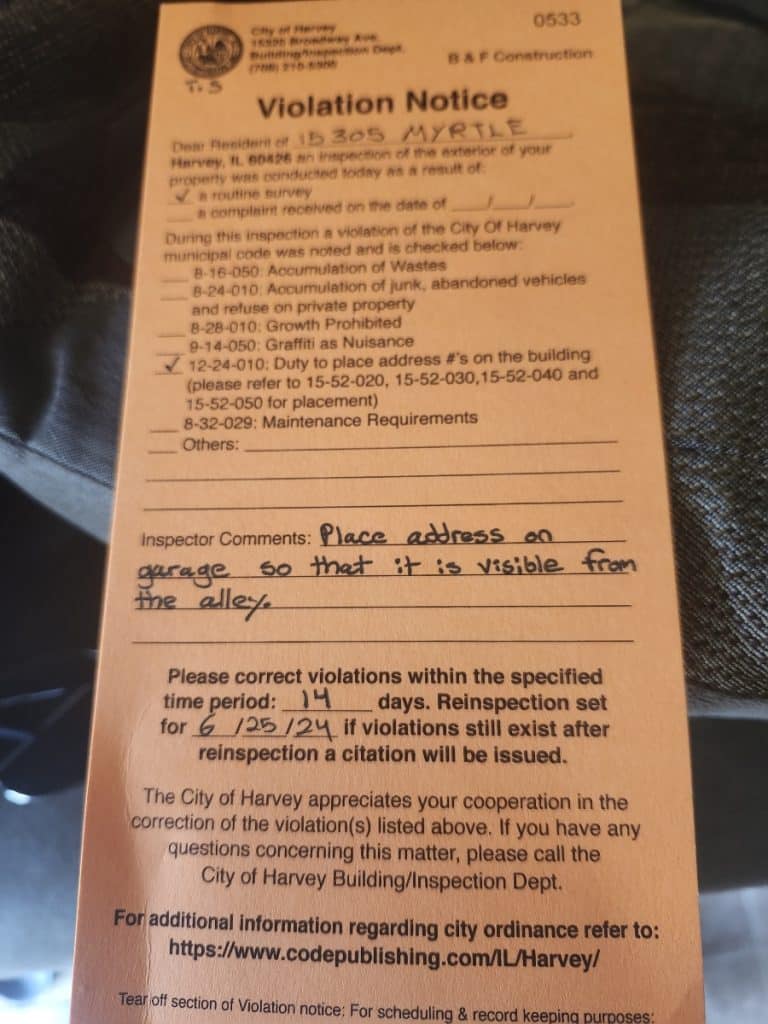
The next month, building inspectors cited Poole-Tingle for failure to display her address on her garage. The city has rarely enforced that law.
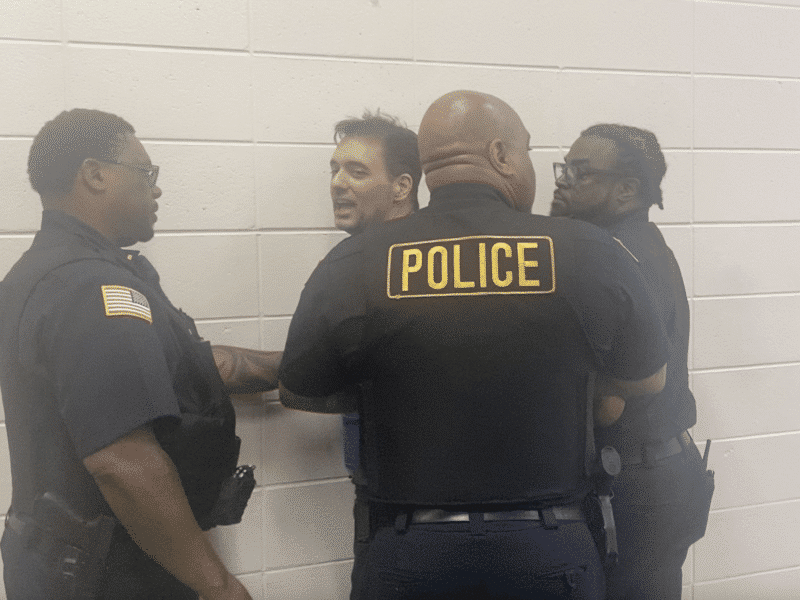
At a City Council meeting, Poole-Tingle accused the mayor of ordering the move and retaliating against her, noting Clark doesn’t have his own address on his garage. Clark laughed as she spoke. The mayor ordered police to arrest Sinwelski that same night.

The impact on seniors
After a month-long hospital stay following a stroke, Rose Smith returned to her cherished home to heal. Smith, 75, acquired her home three decades ago through a first-time homeowner program, believing it to be her forever home.
“Who wants to start over? A younger person, they have 30 or 40 years to do this. With a stroke, I’m not guaranteed another 30,” Smith said last year. “So, let me stay where I’m comfortable.”
Taylor’s abode, purchased in the 1970s, is known among her neighbors for her exquisite garden. Pink flowers accentuate her lime green home. She’s nearly paid her entire mortgage. If Taylor finds a home worth more than her current property, she’ll have to make up the difference, possibly in another mortgage.
But at her age, she and other seniors—well into their 70s and 80s—may not see the end of it.
Awaiting federal funding decision
The District’s $5 million federal funding request to aid construction is still being reviewed.
There’s no current timeline on funding decisions, a grant specialist at the Federal Emergency Management Agency told the HWH.
In its statement, the District didn’t acknowledge the HWH newsroom’s questions about contingency plans should funding not be approved. A spokesperson also indicated it could not comment on ongoing real estate negotiations with Myrtle Ave. residents.
The District has used eminent domain before to combat urban flooding.
In 2015, the District relocated locals to expand its Melvina Reservoir, alleviating flooding concerns for Burbank and Oak Lawn residents. Fifteen homes in Burbank were demolished, none in Oak Lawn.
The District later held an open house to provide feedback on six project ideas, Patch reported. Planning and engineering staff collaborated with municipal officials and residents to develop stormwater management ideas. At the time, Pierre admitted the District favored the project resulting in relocation.
The District did not hold community planning meetings or collaborate with Harvey residents on the water detention pond initiative. According to the district, it mailed surveys to homes.
The District did not provide the HWH with impact data from similar projects that leveraged eminent domain, as requested.
We’re filling the void after the collapse of local newspapers decades ago. But we can’t do it without reader support.
Help us continue to publish stories like these
Authors


Related Articles
EyeOnWater helping Phoenix residents avoid high water bills by spotting leaks
The free online tool allows users to track water usage and set up leak alerts.
All hell breaks loose at Harvey Park District board meeting over alleged mismanagement
The board abruptly adjourned less than 10 minutes after two commissioners called foul on operations, leadership, and finances.
‘Lessons from the Harvey experience:’ MWRD to improve community outreach for future stormwater projects
The Metropolitan Water Reclamation District plans to increase small-group public engagement surrounding future projects involving eminent domain and the acquisition of private property.

