
Police intimidate residents at City Council meeting as brass announces changes to exit procedure
In September, Harvey Police Chief Cameron Biddings announced residents must exit premises after a meeting’s adjournment before the council members can exit the building.
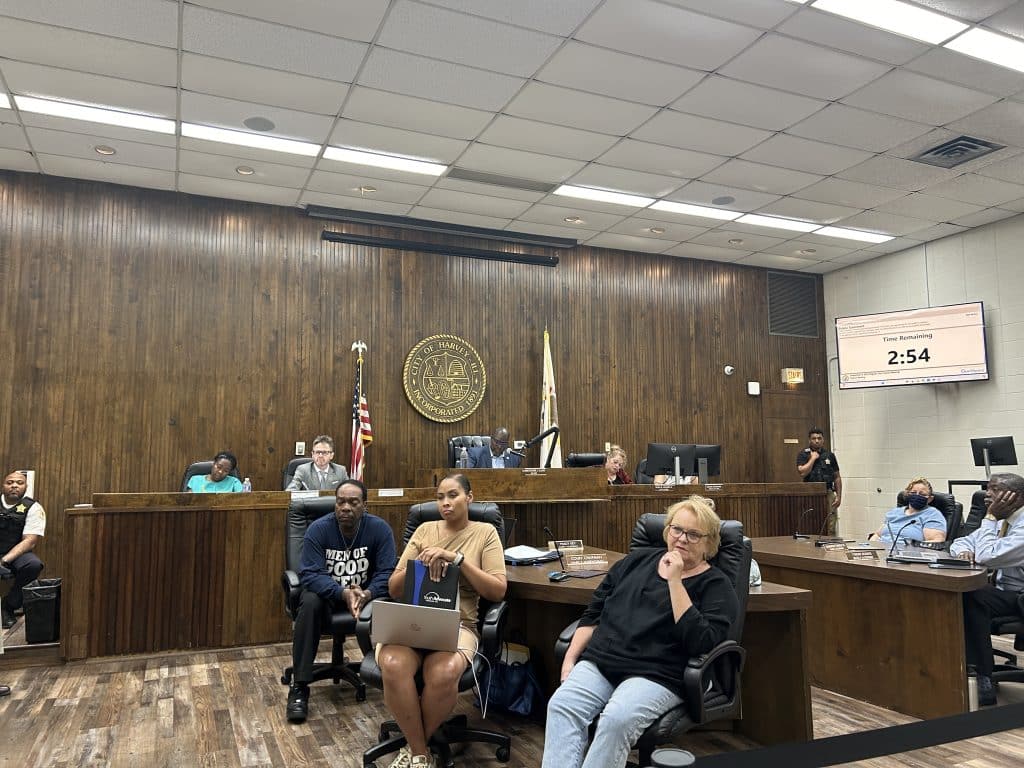
Harvey’s top police brass announced new operational rules for the City Council meetings in September.
It’s common for residents to linger after meetings, reflecting on meeting business.
After adjournment, attendees must exit the City Hall building and premises altogether before city officials can leave, Harvey Police Chief Cameron Biddings said that night. A notice was also posted outside council chambers.
This summer, Mayor Chris Clark ordered police to remove residents after they clapped in response to a speaker blasting him during public comment. Afterward, Clark began reading aloud a disclaimer that effectively bans expression during meetings.
Clark kicked an iteration of that contestable statement on attendee behavior to Biddings, that evening, who cited state law in his defense.
“Disorderly conduct in a public meeting in Illinois involves any unreasonable behavior that disrupts other or disrupts the meetings,” Biddings said, “and it is subject to removal or penalties if it persists after a warning is given. This also includes city employees and council members.”
But that statute is contestable because it’s vague; there’s no stipulations describing what constitutes unreasonable behavior, and that’s how Clark and police have begun abusing the standard.
Rules are selectively enforced. During public comment, police stand directly behind speakers who have repeatedly criticized Clark. And the only council members Clark has ordered police to remove are Alds. Colby Chapman (2nd) and Tracy Key (4th), his two biggest critics.
It all underscores city officials’ attempt to intimidate and condemn the public amidst growing and unrelenting dissent against the Clark administration.
“You know what 10 policemen can do for the city? You know how much money spent for a doggone limousine, parked back there, running gas 24/7?” Melville King, Jr. said. “Do you know how much all of these vehicles around here are costing? You know what you could do?”
He continued: “There is no democracy in Harvey,” said King, Jr., who unsuccessfully ran for the 6th Ward aldermanic seat in 2023. Clark endorsed him. Now, King, Jr., once a community champion of the Clark administration, is one of the mayor’s biggest critics.
“The real issue was that the people who were directly addressing the mayors and alderpersons, they were, as the kids say, butthurt. Your feelings got hurt,” Glynis James-Watson said.
“I guarantee that if the comments made that evening were complementary and glowing, and every one in the chambers stood on their feet to give a rousing ovation and shouts of approval, the chamber would not have been cleared.”
Sharon McGhee, a resident of Myrtle Ave. area, expressed concerns over a $9.85 million water detention pond project on 153rd St. and Myrtle Ave. The joint initiative between Harvey and the Metropolitan Water Reclamation District aims to reduce local flooding.
However, it’s been met with citywide criticism over displacement of longtime residents, crime and stray dog issues nearby, and officials who’ve offered conflicting statements on why that block was chosen as the project site.
“What you’re doing to the community on Myrtle Ave.,” McGhee said, “is not just unethical, it’s unlawful.”
Alders swapped seats after public spatting in council chambers this summer. Ald. Colby Chapman (2nd) previously sat between Alds. Telanee Smith (3rd) and Shirley Drewenski (1st).
Now, Ald. Tracy Key (4th), staunch allies with Chapman, sits in Smith’s old seat on the left side, next to Chapman. Smith now sits in Key’s seat to the right side.
We’re filling the void after the collapse of local newspapers decades ago. But we can’t do it without reader support.
Help us continue to publish stories like these
Author

Related Articles

People over politics: How Kiana Belcher is fighting the Southland political machine
Dolton trustee Kiana Belcher’s most striking qualities are her bluntness and humility. She’s tapping into both to upend politics that prioritizes hubris over public service.
Cook County Assessor Candidate Questionnaire: Fritz Kaegi
Elected in 2018, incumbent Cook County Assessor Fritz Kaegi is seeking a third term in the March 17 primary.
Cook County Assessor Candidate Questionnaire: Pat Hynes
A volunteer firefighter and Lyons Township Assessor, Pat Hynes is a Democratic candidate in the March 17 primary for Cook County Assessor.

