
TTHS D205 digital signage bolstering student engagement, survey suggests
Thornton Township High Schools District 205’s digital signage initiative aims to enhance communication among students and staff, delivering real-time information in a modernized format.

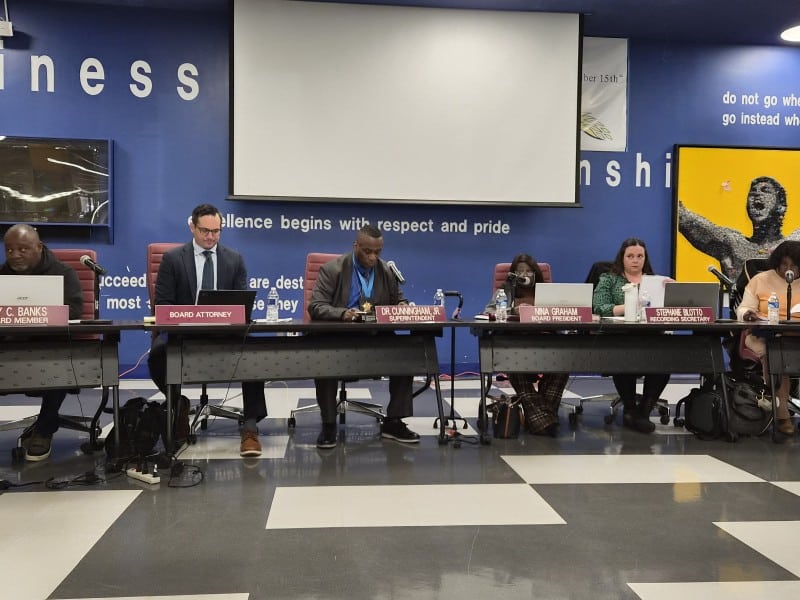
The Thornton Township High School District 205 board reviewed progress on the district’s digital signage initiative at its regular board meeting on June 10, where a survey issued to students shows them becoming better connected to school activities as a result of the district’s effort.
The $35,000 initiative was first announced at the board’s special meeting in February 2025. Each high school received seven digital displays with one 85-inch display installed in the district lobby. Some screens at Thornwood and Thornridge were even turned vertically to display a modern layout students are familiar with, similar to vertical video content on social media. Thornwood purchased additional screens.
The district surveyed 100 students across the three schools to gauge the impact of the new screens and received a “balanced mix” of feedback. Among the students who responded positively, 44.4 percent were from Thornton, 30 percent were from Thornwood, and 25.6 percent were from Thornridge. Nearly 70 percent of students reported regular visibility of the digital signs.
The displays have also bolstered student engagement. More than a third of students reported that they learned about an event or meeting they would have otherwise missed without the screens, and 44 percent of students reported joining a club or scanning a QR code after seeing it on a digital display.
“The data tells us students are seeing the content, they are learning from it, and they are taking action behind it,” said Mary Ann Thornton, the district’s public relations manager.
She also presented a roadmap for phase two of the initiative that would begin in July. The plan starts with schools ordering new screens and media players and expanding active screens across the district. The public relations department also recommended installing a 75-inch screen outside of vocational classrooms at all three schools to showcase students’ work, classroom projects, and career opportunities.
“This recommendation directly supports our district’s promise to prepare students to be enrolled, enlisted, or employed,” Thornton said. “It provides a powerful opportunity to elevate programs that lead directly to meaningful careers.”
In the fall, the district would begin testing out REACH, a cloud-based digital signage software and content management systems provider, to evaluate staff accessibility and layout options. Thornton said that while the district’s current signage software, Vivi, has been performing well, the public relations department wants to test other softwares to ensure the district is getting the best value.
“We will be testing the REACH TV option to allow us to compare functionality, usability, and long-term value before entering into any significant contractual commitments,” Thornton said.
She proposed a cost-effective expansion strategy where the district would continue to cover software licensing fees while individual schools cover the cost of the physical screens based on their needs and priorities.
“Individual schools would have the opportunity to expand locally through additional monitors, parent-facing displays, and repurposed equipment,” Thornton said.
“As we consider future expansion, we remain committed to evaluating options carefully,”
Thornton also shared that the department plans to use low-cost adapters to upscale older school equipment like smartboard panels and Prometheans into digital signage. “This allows us to increase the communication reach while minimizing our costs.”
Superintendent’s report
Superintendent Nathaniel Cunningham, Jr. shared insight from his participation in a convening with Illinois Workforce and Education Research Collaborative (IWERC) where he was a panelist and served on the advisory board. The convening focused on Black student success in Illinois, bringing together stakeholders to examine Black students’ education-to-career trajectories.
“One of the strongest things throughout the convening was that access alone is not enough,” Cunningham, Jr. said. “Educational systems must move beyond measuring participation and instead focus on measurable outcomes and long-term success for our students.”
Participants of the convening emphasized the importance of strong leadership systems and career-connected opportunities to improve Black student success. They also stressed the importance of Black-serving districts not being viewed through a deficit lens but as “systems capable of becoming statewide models of success when properly aligned and supported.”
“As the superintendent, I believe District 205 is positioned to continue leading this work,” Cunningham, Jr. said. “The responsibility is not simply to graduate students but ensure they leave our district prepared to thrive.”
All other agenda items were either tabled for next month’s meeting or had nothing to report on at this time.
We’re filling the void after the collapse of local newspapers decades ago. But we can’t do it without reader support.
Help us continue to publish stories like these
Author

Related Articles
WHD SD147 students prompt upward trend in math and reading skills, data show
The district’s curriculum department reported growth in reading and math proficiency among students, highlighting cohorts that showed sustained academic advancement year after year.
In compliance with state law, TTHS D205 addresses immigration policy after criticism
Superintendent Nathanial Cunningham, Jr. defended the district, saying they’re following appropriate protocols, as required by the state’s July 1 deadline.

Riverdale native Kathryn Varner named next superintendent of SH SD151
She has worked for South Holland School District 151 for 25 years, beginning as a paraprofessional.

