
‘All Americans’ : Southland leaders call on Trump administration to reject polarization and issue disaster aid
Local mayors joined 2nd congressional district leadership to reject political partisanship, pleading for aid from the federal government during an unprecedented storm surge.
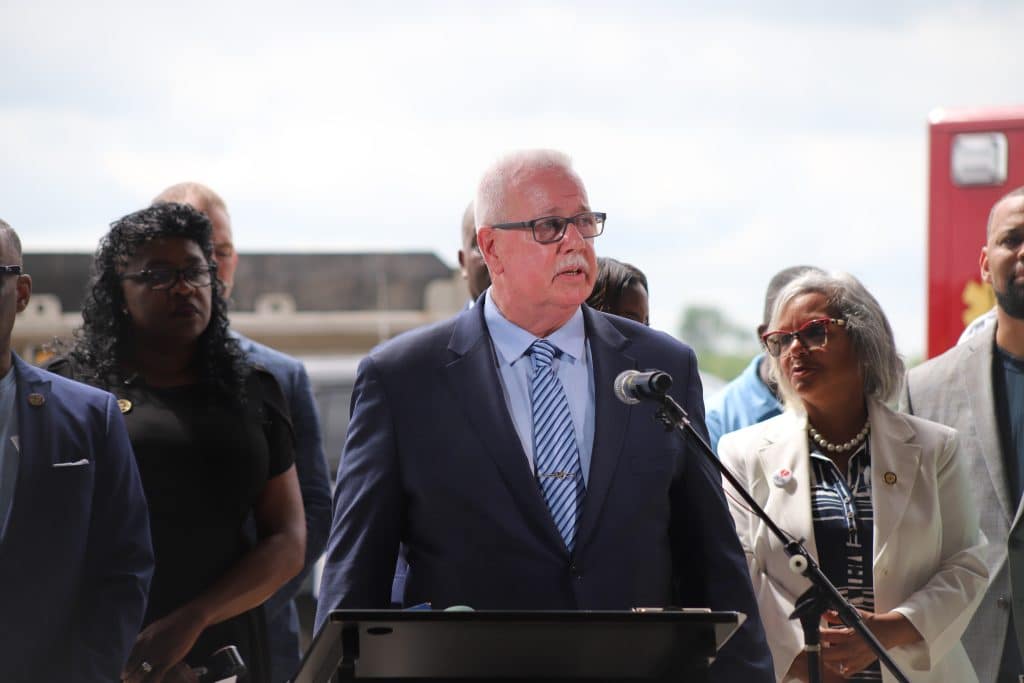
2nd Congressional District Democratic nominee Donna Miller joined Southland leadership to push for federal disaster assistance after weeks of torrential downpour and tornadoes have brought several municipalities to a near standstill.
“Climate change does not obey municipal borders or state lines. They are neither red nor blue,” said Miller, adorning a pin reading “I [love] LANSING.” Disaster assistance is “not a favor” from the president, Miller said, rather “it’s a commitment that our government makes to every American in a time of need.”
Illinois and the Trump administration have not maintained a working relationship: the federal government denied two of the state’s requests and appeals for disaster assistance from 2025.
But “if we don’t try, we’re guaranteed we’re not going to get anything,” said outgoing United States Rep. Robin Kelly (D-Ill.) when asked by the H-F Chronicle about contingencies should that pattern hold. Still, her staffers will also explore other funding mechanisms if emergency aid does not materialize.
However, it must step up regardless of partisanship, south suburban mayors stressed Sunday at Lansing Municipal Airport.
‘Southland strong’
Just minutes away from the airport, traffic lights are still out along Glenwood-Lansing Rd. and Wentworth Ave. days after Lansing was rocked by an E-1 tornado on August 11. That day, a derecho ripped through the area, bringing wind gusts between 70 and 100 miles per hour, according to the National Weather Service.
“It doesn’t matter what color your state is — we’re all Americans, and we need to stand together in a time of need” and remain “Southland strong,” said Lansing mayor Brian Hardy, flanked by mayors from Glenwood, Richton Park, Dolton, Park Forest, Homewood, and University Park.
Damage is extensive. Illinois is experiencing an unprecedented storm surge, on track to record its highest number of tornadoes on record.
The tornado “plowed through the village of Flossmoor like the 1980s [Chicago] Bears offense,” said mayor Michelle I. Nelson, with costs soaring “6,000 to $20,000 per property to clear the debris […].”
The county has leveraged transportation and emergency management personnel to help with debris removal. Harvey, Markham, South Holland, Palatine, and Hoffman Estates sent public works to other areas to assist, Nelson said. But it’s not enough.
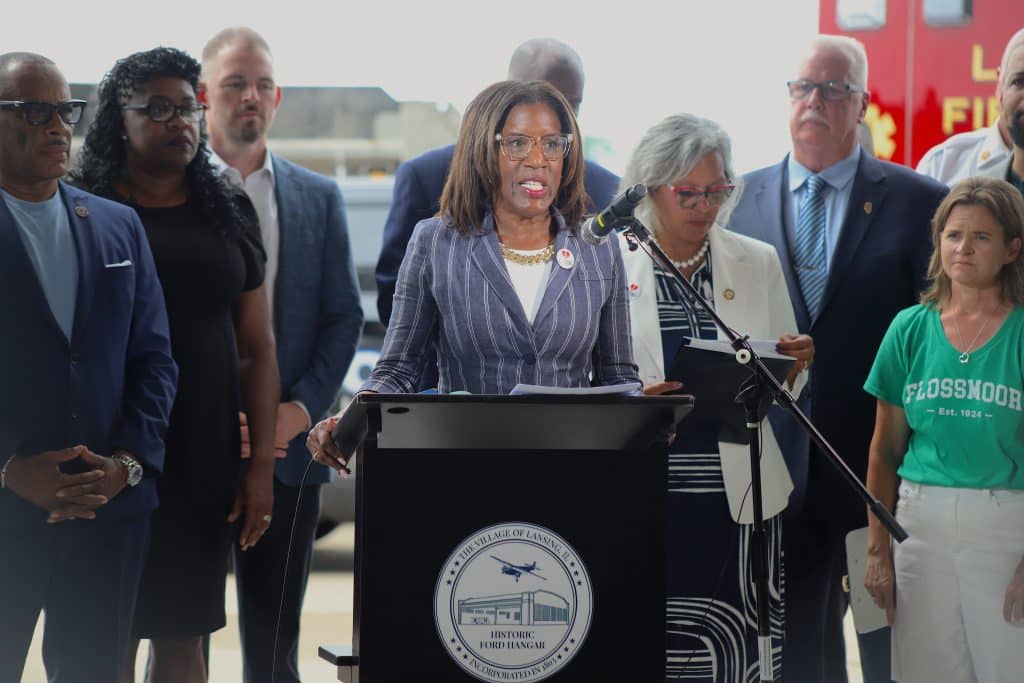
“Our residents have worked hard, paid their taxes, built their businesses, raised their families, and invested in these communities,” said Lynwood mayor and South Suburban Mayors and Managers Association president Jada Curry, whose fence was toppled and has downed trees in her yard. Be patient, be neighborly, and be safe, Curry advised residents.
Cook County issued a disaster declaration for July 27 and August 11 storms, with President Toni Preckwinkle visiting Flossmoor last week. Cook County is circulating a damage survey. Miller, currently a Cook County Commissioner of the 6th district, urged the public to complete it. The deadline is August 24. Report damages here.
Illinois must follow suit with its own proclamation before Kelly would issue a federal request. She lives in Lynwood, and cut travel short and returned home following storms. “FEMA would be hearing from my office Monday night,” Kelly said.
Governor JB Pritzker was not at the presser, but surveyed damage in Lansing the day before, the Lansing Journal reported. But Pritzker, who did not take questions from the press, received flack from locals on the state’s slow response. A state proclamation is forthcoming, said Illinois State Rep. Marcus Evans (D-33).
Politicization of aid
It’s questionable whether the Trump administration would even be willing to deliver aid for those affected. In the early days of Trump 2.0, the federal government began clawing back aid and research grants it had already approved for municipalities, colleges, and agencies.
And while officials denied those decisions were influenced by partnership, United States Department of Energy attorney Jeff Novak recently conceded 284 research grants were cancelled if Trump lost that state in the 2024 presidential election, according to court filings in a suit brought by the University of California challenging terminated research grants.
The now shuttered Department of Government Efficiency oversaw the layoffs of hundreds of thousands of federal workers, neutering some departments with a broader desire to shutter them altogether, although that requires congressional approval. The Federal Emergency Management Agency wasn’t spared.
In April 2025, FEMA moved to axe its Building Resilient Infrastructure and Communities portfolio, funds used to help historically marginalized communities become more environmentally resilient.
Three months later, Illinois Attorney General Kwame Raoul’s office joined 19 other states in a lawsuit seeking a preliminary injunction on the BRIC terminations. A federal judge in Massachusetts granted the motion in December 2025, and issued another order in March to enforce it after the Trump administration provided a timeline to restore funding. Grants from the 2020-23 period, however, will not be restored.
The Fixing Emergency Management for Americans Act, or FEMA Act, is bipartisan legislation that would move FEMA from the Department of Homeland Security and re-establish it as an independent cabinet-level agency and increase funding. Introduced in September 2025 by Rep. Sam Graves (R-Mo.), it has stalled in the House. Miller pushed for its passing.
The state reimburses Supplemental Nutritional Assistance Program recipients for spoiled food incurred during a power outage if they file a claim within 10 days, for instance.
But roughly 23 percent of Cook County households have seen a reduction or complete loss in benefits after the sweeping One Big Beautiful Bill Act tightened eligibility requirements in the year following its passage, state data show, meaning fewer families across the area will be able to take advantage of state aid following summer storms. Miller committed to reinstating SNAP benefits if elected to Congress.
Southland homeowners and renters are now finding their insurance does not cover flood damage, must get a separate policy, or are denied a separate policy altogether. Miller lives in a flood zone in Lynwood but cannot get flood insurance, she said. Miller also believes insurance companies should educate homeowners about their policies and types of insurance available.
We’re filling the void after the collapse of local newspapers decades ago. But we can’t do it without reader support.
Help us continue to publish stories like these
Author

Related Articles
Dixmoor launching water meter replacement program at no cost to residents
Calumet City Plumbing will inspect and replace meters citywide. The move will also allow the village to transition out of the estimated billing system.

Pace to celebrate Dolly Day with little libraries across six transit stations, including Harvey
September 25 is Dolly Day, in honor of late singer Dolly Parton and her hit single and film “9 to 5.” Straphangers can take and leave a book at the Harvey bus station, along with five other locations.
Harvey taps Anchor Heavy Civil to repair water main and replace flow meters
The city will employ Anchor Heavy Civil to install new flow meters at O’Connor Pumping Station and repair a water main near 151st and Morgan streets. City officials said these improvements will save thousands of dollars in water bills.


